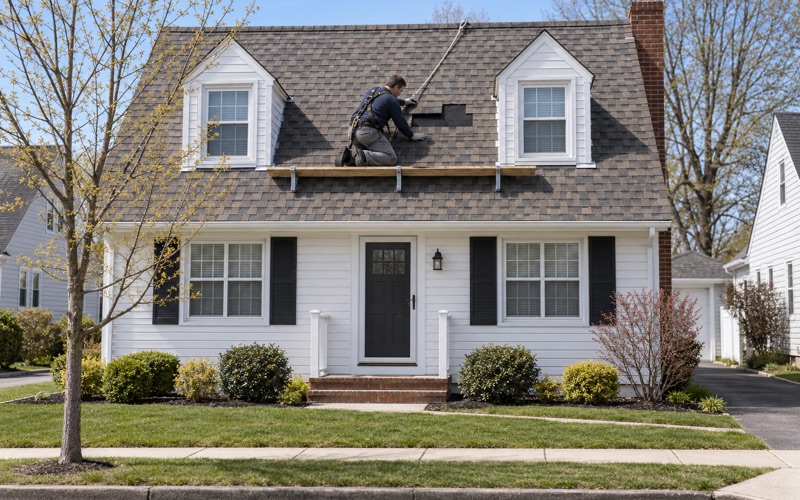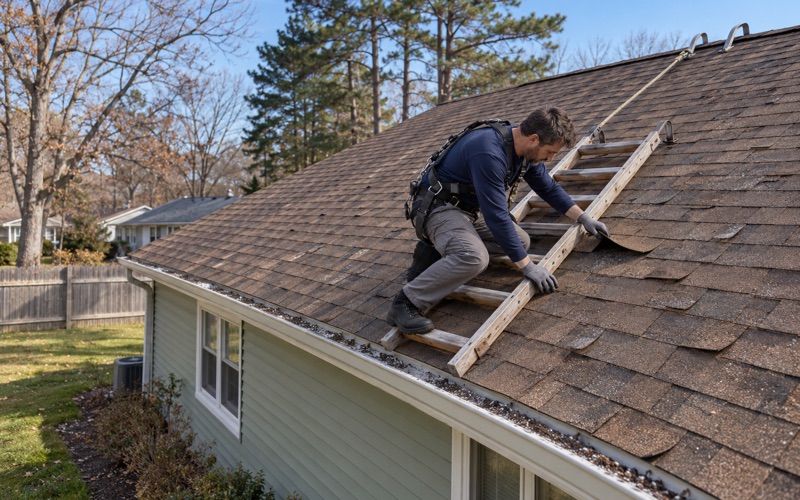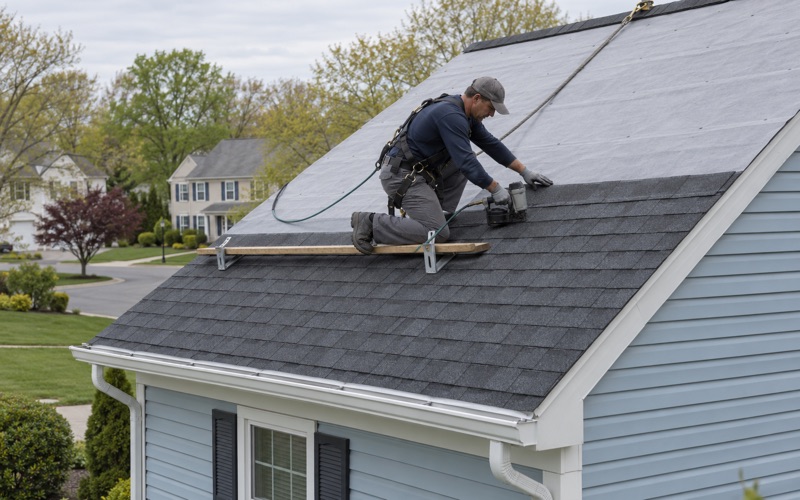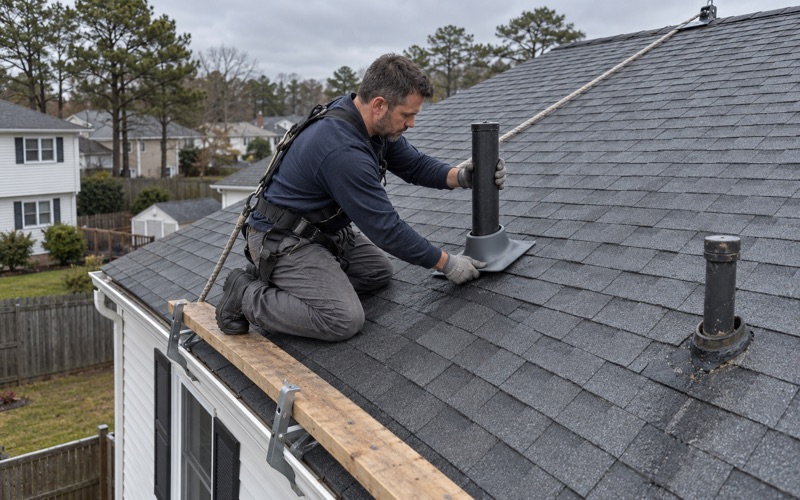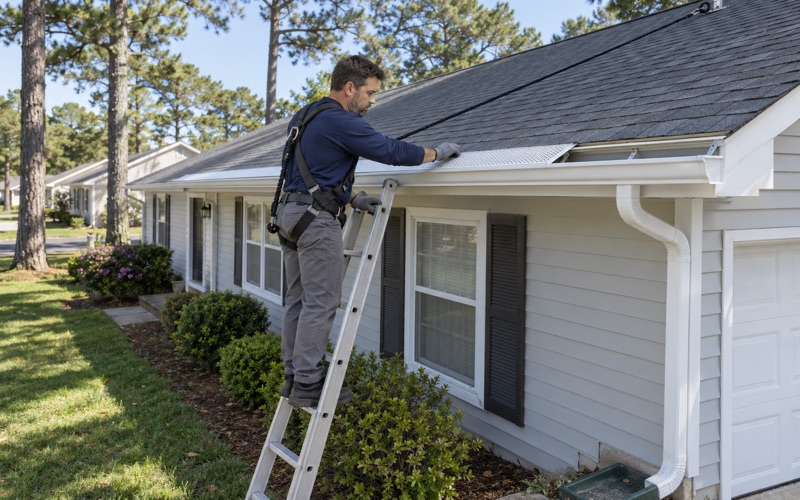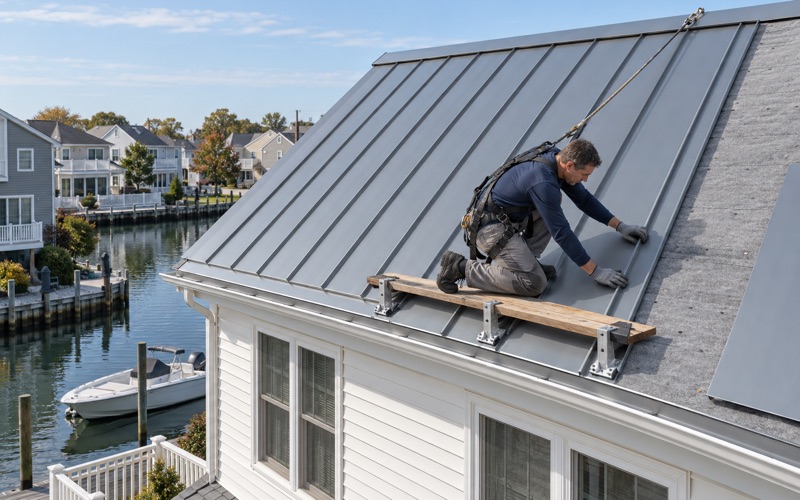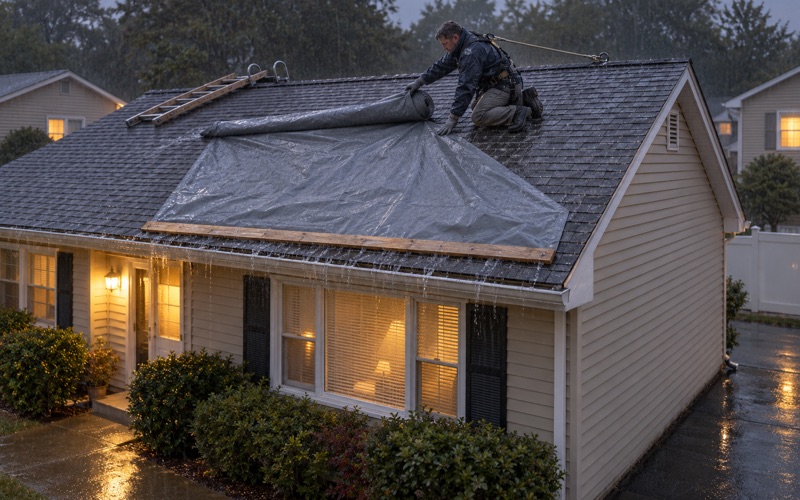
Brick Roofing has handled roofing in Wall for more than 20 years, and the work here runs from shingle repairs on family houses to low-slope roofs on the businesses that line the township’s busy roads. Before any price is written, we want to know what is actually wrong, where water is getting in, and whether the roof in front of us can be fixed.
That order matters on every call. A leak gets a look in the attic as well as on the roof surface, because water often travels along a rafter or the deck before it shows up on a ceiling. Once we have found the entry point, you get a plain answer on repair before anyone mentions a new roof.
When replacement does make sense, the estimate is written as separate lines for tear-off, decking, underlayment, flashing, ventilation and gutters. That way you can lay two bids side by side and compare them item by item instead of trying to read one lump sum against another.
The 2019 Storm on Route 34
Wall Township has a storm record of its own, and it sits on its commercial corridor rather than in a residential neighborhood. It is a useful reminder that serious wind damage does not need a funnel cloud.
What the Weather Service Survey Found
On the night of Thursday, October 31, 2019, into early Friday, November 1, a line of thunderstorms crossed the township. Two commercial buildings at Monmouth Executive Airport, 1717 Route 34, collapsed, one of them housing Triple C Tires. A recreational vehicle was damaged, and no one was hurt in the overnight storm.
A National Weather Service team from the Mount Holly office surveyed the area near the Monmouth Jet Center airfield in the days after. They found structural beams thrown more than 300 feet into a field, a recreational trailer rolled about 50 feet, and utility poles along Route 34 snapped or knocked down. Neither the local report nor the survey described damage to the roofs of houses.
Straight-Line Wind, Not a Tornado
The survey’s conclusion was straight-line wind, which the weather service described as the outflow generated by a thunderstorm downdraft. It was not a tornado, and no wind speed was published for the event. Air dropping out of a storm cell hits the ground and spreads outward, pushing hard in one direction rather than rotating.
That distinction matters to anyone who owns a building. Many people assume a roof is only at risk when a tornado warning is issued, yet a severe thunderstorm warning can bring wind strong enough to move steel beams. In Wall, a summer or fall storm deserves the same attention afterward as a named weather event.
Why a Downdraft Finds the Roof Edge
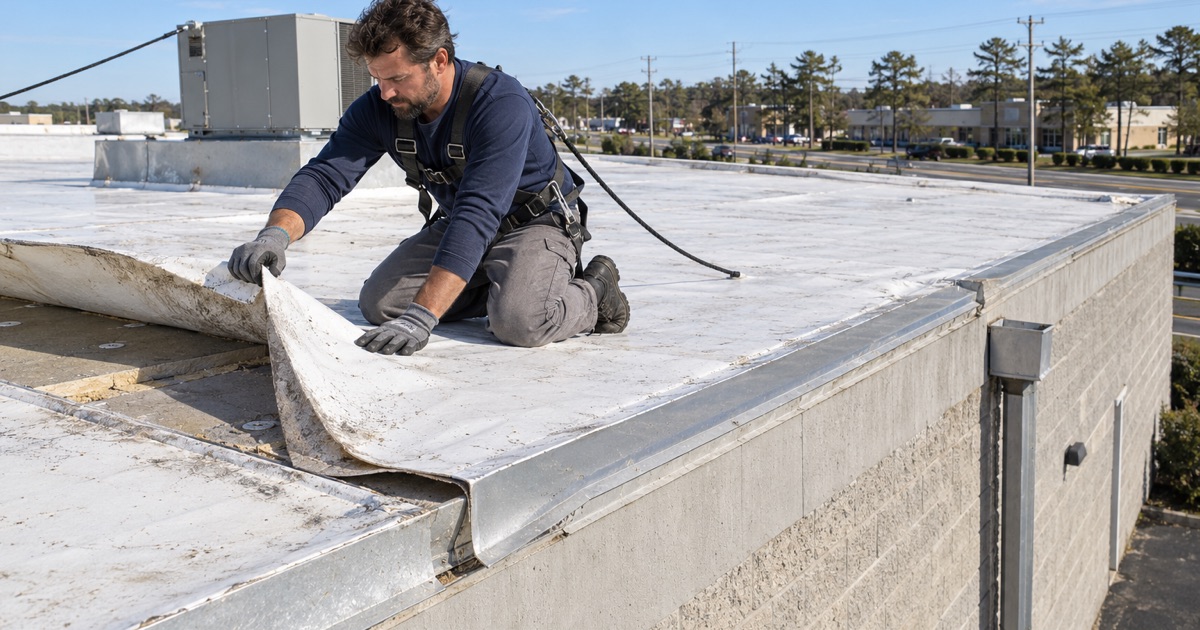
Wind moving across a roof creates lift, and that lift is strongest at the edges, corners and any spot where a membrane or shingle is already loose. A flat or low-slope roof has a long, exposed perimeter, so a single gust along the edge can start peeling material back. We think it is reasonable to treat straight-line wind as a real threat to low-slope roofs generally.
Once air gets under a membrane, the damage spreads quickly. A section that lifts can pull insulation boards with it, let rain into the building and leave the rest of the roof working against wind it was never anchored to resist. That is why the perimeter is where we look first.
Looking for roofing closer to Dover Beaches South? See Roofing Services in Dover Beaches South.
Commercial and Flat Roofs Along Wall’s Highway Corridors
Wall is crossed by several highways, and Route 34 and Route 35 carry a long string of shops, service businesses, offices and light industrial buildings. Many of them sit under flat or low-slope roofs that behave very differently from a pitched house roof.
Membranes, Seams and Perimeter Metal
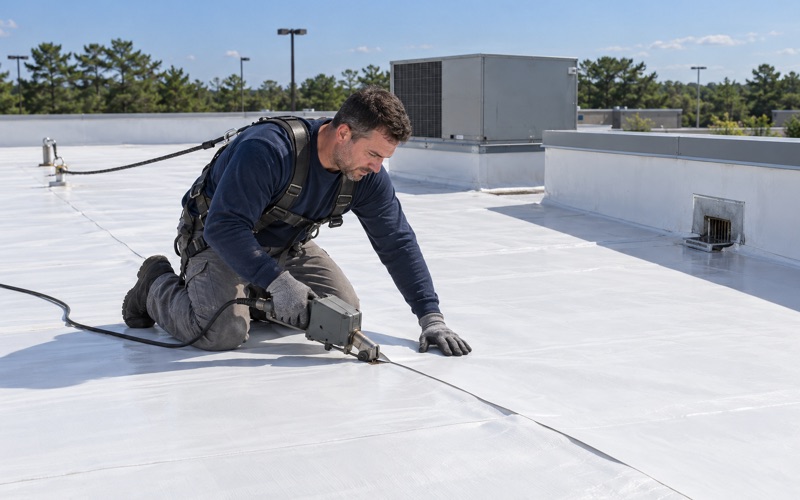
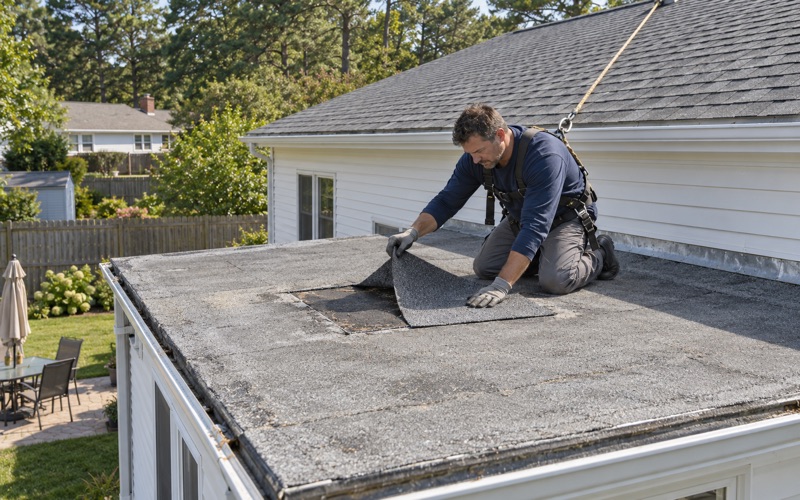
The low-slope roofs we see on highway businesses are usually EPDM rubber, TPO or PVC single-ply membranes, or torch-down modified bitumen. Each one depends on sound seams and a secure edge. When we inspect a commercial roof, we walk the seams, check the termination bars and the perimeter metal, and look for any spot where the membrane has started to lift or wrinkle.
A membrane that is fully adhered behaves differently from one that is mechanically fastened or ballasted. We note which system you have, because the repair for a lifted seam on one is not the repair for another. Your written report names the system and the specific areas that need attention.
Rooftop Units, Curbs and Drains
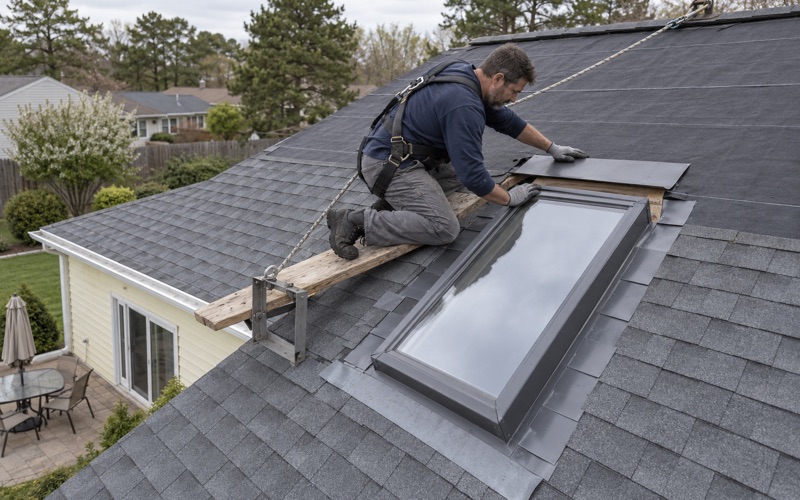
Commercial roofs carry equipment, and every penetration is a place for water to enter. Heating and cooling units sit on curbs that need intact flashing, while vent pipes need sound pipe boots. Skylights, whether curb-mounted or deck-mounted, need flashing that has not pulled away after years of heat and cold.
Drainage is the other half of a flat roof. Ponding water after a storm points to a clogged drain, a sagging deck or a low spot that was never sloped properly. We check drains and scuppers on every visit, because a roof that holds water ages faster and is heavier when the next storm arrives.
Planning Work Around an Open Business
A store or shop along Route 34 usually needs to stay open while its roof is repaired. We plan access, staging and debris control before the crew arrives, so customers and deliveries are not blocked. At the end of each work day, the lot and the gutters are cleaned, including a magnet sweep for loose nails near parking spaces.
Checking a Roof After a Severe Thunderstorm
After a hard storm, the first look should come from the ground. You do not need to climb a ladder to spot most warning signs, and climbing a wet roof after high wind is how people get hurt.
What You Can See From the Yard or Lot
On a house, walk around and look for missing shingles, creased tabs, granules collecting at downspouts, and drip edge or gutters pulled away from the fascia. On a commercial building, look along the roofline for bent metal edging or a membrane flapping in the breeze. Debris on the ground from a neighboring property is a sign the wind was strong enough to matter.
Inside, look for fresh stains on ceilings, damp insulation in an attic or a musty smell that was not there before. A building can lose material without leaking right away, so we suggest checking again after the next rain even when the first walk-through looks fine.
What We Check Up Close
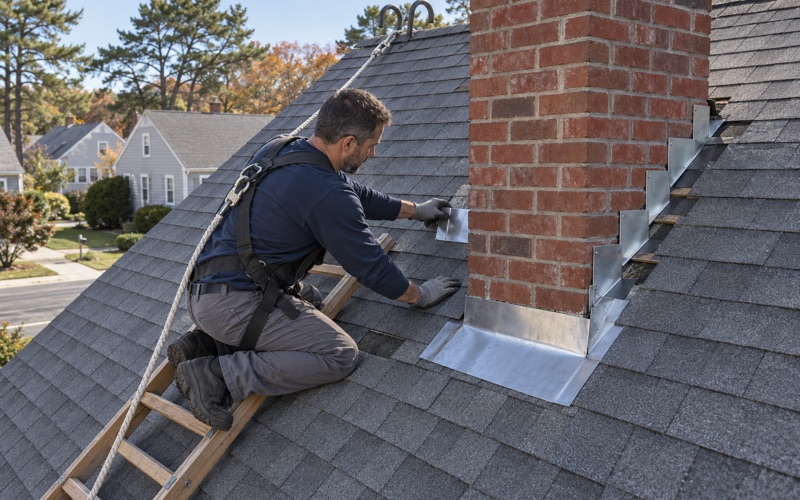
When we inspect after a storm, we go through the roof surface, the flashing at walls and chimneys, the ridge and the edges. Then we go into the attic or above the ceiling to trace any moisture to where it actually enters. Shingles that look intact can still have broken seals, which only shows when you lift a tab by hand.
We also look at what the storm did not touch. Older damage, worn flashing or a deck that was already soft can be mistaken for new storm damage. Separating the two keeps your repair accurate and keeps any claim you file honest about what the wind actually did.
Documenting Damage for an Insurance Claim
If the storm left real damage, we photograph it and write it up so you have a clear record for your own claim. When you ask, a member of our crew will meet the insurance adjuster on site and walk the roof with them. The claim stays yours; our job is to show plainly what we found.
For owners who are away when a storm passes through, we can inspect the roof and send a photo report the same day. That gives you something concrete to act on before a small opening turns into wet insulation and stained ceilings.
Wall’s Detached Houses and Their Roofs
For all the attention the airport corridor drew in 2019, Wall Township is mostly a place of single-family homes. The township was incorporated in 1851 from part of Howell Township, and its housing has been added steadily ever since.
A Housing Stock From Every Decade
Census figures show that 8,406 of the township’s 10,397 housing units are one-unit detached houses, about 80.9 percent, and 83.4 percent of occupied homes are owner-occupied. The stock spans every decade, with 1,183 units dating from 1939 or earlier and 2,228 built in the 1990s alone. That spread means we see very different roofs from one street to the next.
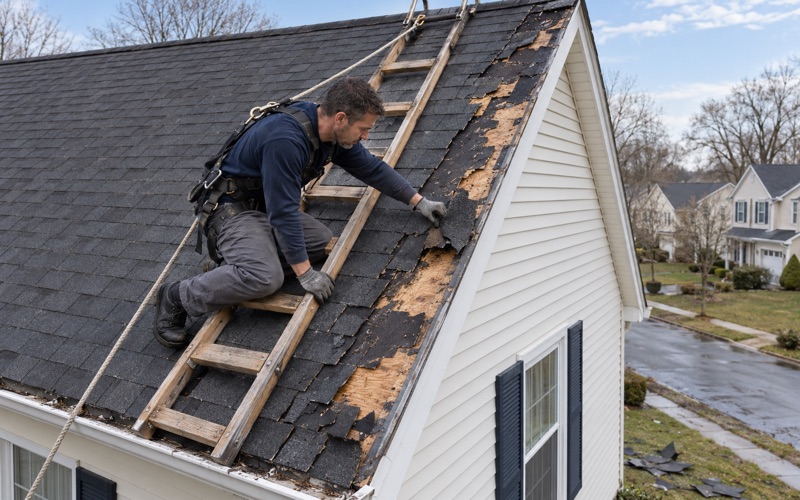
A house from the 1990s may be on its first or second asphalt roof, often three-tab shingles that are reaching the end of their life. Newer homes more often carry architectural shingles. When we tear off, any damaged decking is photographed and shown to you before it is replaced, at the per-sheet price written into your contract.
Wind Ratings Matched to Your Address
Wall spans two National Weather Service forecast zones, with its interior in Western Monmouth and its eastern edge in Eastern Monmouth. We do not lean on that for shingle choice, though. Wind ratings are matched to the design wind speed for your exact address rather than a guess for the whole township.
That can mean shingles tested to ASTM D3161 Class F or ASTM D7158 Class H, laid with high-wind six-nail fastening and a sound starter course at the eaves. If solar panels are on the roof, their removal and reinstallation are built into the schedule from the start, so nothing is discovered on the day of the job.
Contracts Written for New Jersey Homeowners
Every home contract we write follows New Jersey’s home improvement rules, including the three-business-day cancellation notice. If you live in a community with an association, we check the master deed or bylaws first so you know whether the roof is your responsibility or the association’s before any work is scheduled.
- 20+ Years in Roofing
- Attic and Roof Leak Checks
- Line-Item Written Scopes