
Brick Roofing offers skylight installation in Brick, NJ, serving surrounding cities including Point Pleasant, Leisure Village East, Brielle, Point Pleasant Beach and Leisure Village. As roofers with 20+ years of experience, we approach a skylight as a hole in the roof that has to stay dry for decades, and the flashing around it gets as much attention as the glass itself.
We install new skylights in rooms that need daylight, and we replace old units that have fogged, cracked or started leaking. Most skylight leaks we are called to were never the fault of the skylight; they came from flashing that was skipped, cut short or replaced with a ring of sealant that dried out within a few years.
Before anything is installed, we look at the attic and the framing where the skylight will go and explain what the opening, the light shaft and the flashing involve. The estimate lists each part separately, so the skylight, the framing and the roofing work are all clear on paper.
Choosing a Skylight
Curb-Mounted Skylights
A curb-mounted skylight sits on a raised frame, or curb, built above the roof deck. The curb lifts the unit above water flowing down the roof and is flashed like a small chimney. Curb-mounted units suit low-slope roofs and are often the simplest way to replace an older skylight that was already installed on a curb.
Because the curb is built on site, it can be sized to an existing opening, which avoids reframing the roof when an old unit is swapped out. We flash the curb with step flashing on the sides, a head flashing at the top and an apron at the bottom, the same way we would flash a chimney.
Deck-Mounted Skylights
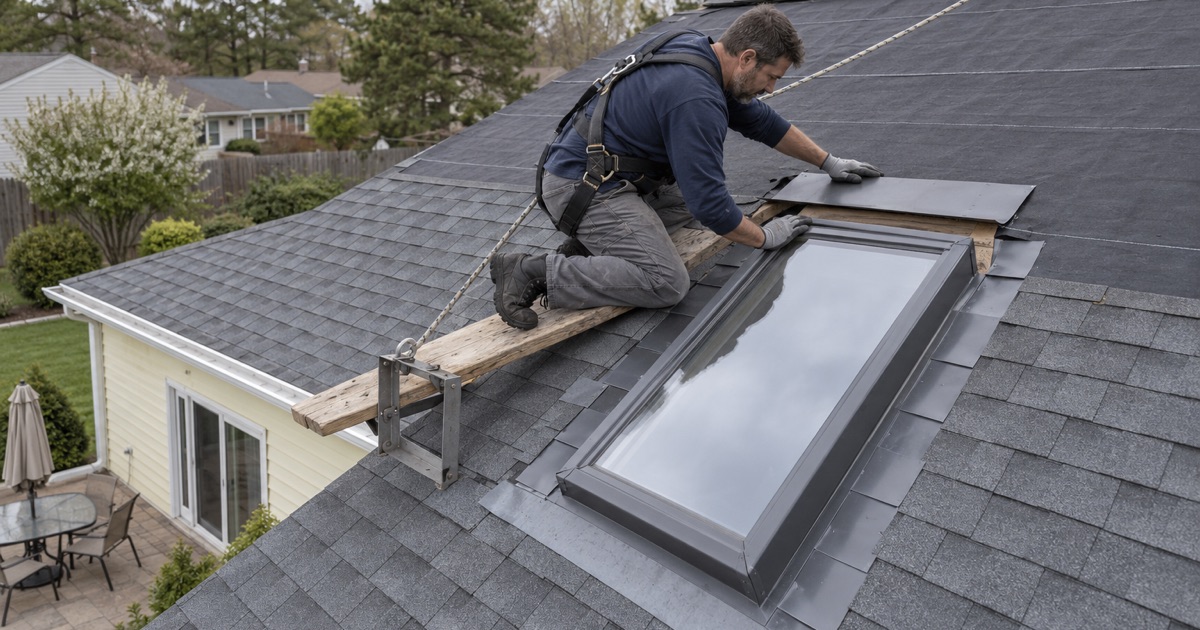
A deck-mounted skylight fastens directly to the roof deck and comes with its own engineered flashing kit. It sits lower on the roof and gives a cleaner look on pitched roofs. Installed with the manufacturer’s flashing and an ice and water barrier collar, a deck-mounted unit is one of the most reliable ways to bring daylight through a shingle roof.
Fixed and Venting Units
Fixed skylights let in light only. Venting skylights open to release warm, moist air, which is useful in bathrooms and kitchens where condensation builds up. Some open manually and others electrically. We help you choose based on the room, what is below the skylight and whether you can reach it.
Glazing matters too. Low-emissivity coatings and laminated or tempered glass reduce summer heat and winter heat loss and improve safety overhead. A skylight on a south- or west-facing slope can add a lot of heat on a summer afternoon, so we talk through placement and glazing together rather than treating the skylight as a hole with glass in it.
Placement on the Roof
Where the skylight goes affects both the light it brings in and how well it stays dry. We avoid placing units directly below valleys or other spots where water concentrates, and we check for wiring, ducts and framing in the attic before choosing the exact position. On roofs with solar panels, we plan around the array so neither shades or blocks the other.
Installing the Skylight
Framing the Opening
A new skylight needs an opening cut in the deck, and often a header and trimmers framed between rafters to carry the load around it. Where a skylight is wider than the rafter spacing, we frame around it so the roof structure stays sound. Every cut is planned from inside the attic before we start on the roof.
Ice Barrier and Flashing
Around the opening we install ASTM D1970 self-adhering ice and water barrier lapped onto the curb or the skylight frame. Step flashing is woven into each course of shingles along the sides, with head and sill flashing at the top and bottom. This layered approach keeps water out even if wind drives rain under the shingles around the skylight.
Near the ocean and the bay, we choose flashing metal and fasteners suited to salt air, so the details around the skylight do not corrode before the rest of the roof does. The metal used is named in the estimate.
Building the Light Shaft
Between the roof and the ceiling, the skylight needs a shaft to carry the light down. We frame and insulate the shaft so warm air from the room does not condense against cold surfaces in winter, and leave it ready for drywall and paint. A flared shaft spreads the light more widely across the room below.
Replacing and Repairing Skylights
Replacing Old or Fogged Units
Older skylights fog between the panes when their seals fail, crack with age or develop leaks around their frames. Replacing the unit together with new flashing restores both the view and the weather protection. Where the existing opening is a standard size, the new skylight can often fit with little change to the framing.
Fixing Leaking Skylights
When a skylight leaks, we first check whether the water is coming from the flashing, the frame, the glass or condensation inside. Many leaks are fixed by reflashing the existing unit properly. If the skylight itself has failed, we recommend replacement and show you the evidence.
Skylights and a New Roof
A roof replacement is the best time to replace or reflash a skylight, because the shingles and flashing around it are coming off anyway. We plan the skylight work into the roof job and list it as its own line, so you can see what it adds to the total.
Doing both together also avoids a common problem: a new roof installed around an old skylight whose flashing was reused. That old flashing often fails within a few years and forces the new shingles around the skylight to be disturbed for a repair.
- 20+ Years in Roofing
- Attic and Roof Leak Checks
- Line-Item Written Scopes