
Brick Roofing carries out roof replacement in Brick, NJ, serving surrounding cities including Point Pleasant, Leisure Village East, Brielle, Point Pleasant Beach and Leisure Village. Over 20+ years we have replaced roofs on ranches, capes, split-levels, raised shore houses and commercial buildings, and every one starts with the same question: does this roof actually need replacing?
We answer that honestly. If a repair will give the roof several more good years, we tell you and quote the repair. When the shingles, decking or flashing have reached the end of their life, we explain why with photographs from the roof and from the attic, so the decision rests on evidence rather than a sales pitch.
When replacement is the right call, the estimate breaks the job into separate lines: tear-off and disposal, decking, underlayment, flashing, ventilation, shingles and gutters. You can set it beside any other quote and compare the two item by item, which is the only fair way to compare roofing bids.
Planning the New Roof
Inspection and Layer Count
Every replacement begins with an inspection of the roof and the attic. We count the existing layers, look for sagging or soft decking, check the framing for old water damage and note how the attic is ventilated. That tells us what the tear-off will uncover and what needs to be budgeted before work starts.
The layer count matters because New Jersey’s rehabilitation subcode, N.J.A.C. 5:23-6, requires a full tear-off when a roof already has two or more layers. Many older Brick homes have been re-roofed over the original, so a full strip to the deck is usually part of the plan.
Wind Rating for Your Address
New Jersey points to a site-specific design wind speed through the ASCE 7 hazard tool referenced in DCA Bulletin 19-1. A house on the barrier island faces very different wind than one inland near the Garden State Parkway, and a ZIP-code figure can underestimate an exposed site. We look up the exact address before choosing shingles and fastening.
That figure guides the shingle choice, such as products tested to ASTM D3161 Class F or ASTM D7158 Class H, and the nailing pattern. On exposed homes we use the manufacturer’s high-wind fastening, typically six nails per shingle, because a wind rating only holds when the shingle is fastened the way it was tested.
Choosing Shingles and Color
Architectural, or laminated, shingles are the standard choice on most homes we replace. Lines such as GAF Timberline HDZ, Owens Corning Duration and CertainTeed Landmark offer a wide range of colors along with wind ratings, and some products carry a UL 2218 Class 4 impact rating or an ASTM E108 / UL 790 Class A fire rating.
Color is a long-term decision, since the roof will be on the house for decades. We bring real samples and hold them against the brick, siding and trim in daylight, which shows far more than a small printed chip. Darker blends often suit red brick, while lighter grays sit well on newer siding.
Standing Seam Metal as an Option
For homes close to the water, standing seam metal roofing is worth considering. It sheds wind-driven rain well and, with panels, clips and fasteners chosen for salt exposure, holds up to coastal conditions. We price it alongside shingles where it suits the house, so you can compare both on the same terms.
The Tear-Off and Installation
Protecting the Property
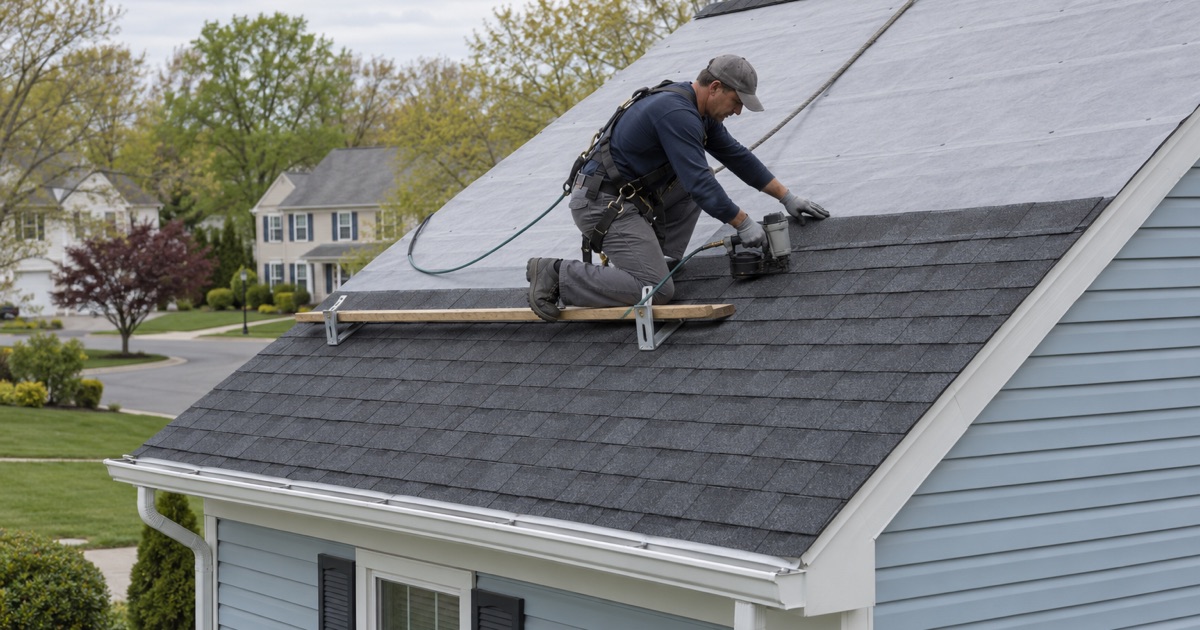
Before the first shingle comes off, we position the dumpster, cover shrubs and plantings, protect windows and doors and set up a clear path for debris. On raised houses we set up the lift or staging and fall protection planned during the inspection, so the crew works safely at height from the first hour.
Stripping to the Deck
The old shingles, underlayment and worn flashing come off down to the wood. With the deck exposed, we inspect every sheet for rot, delamination and old leak damage. Any damaged decking is photographed and shown to you before it is replaced, at the per-sheet price already written into the contract.
Plank decking on older houses sometimes has gaps or boards that have split over the years. We repair or overlay it as needed so the new shingles are fastened into solid wood, since nails driven into a gap or a cracked board hold almost nothing.
Underlayment and Ice Barrier
Along the eaves, valleys and around penetrations we install ASTM D1970 self-adhering ice and water barrier, which seals around nails and keeps out water backed up by ice dams or wind-driven rain. The rest of the deck gets a synthetic underlayment meeting ASTM D8257, which resists tearing and stays flat during installation.
Flashing and Drip Edge
New drip edge goes on at the eaves and rakes, and every chimney, wall and penetration gets new flashing: step and counter flashing at chimneys, apron and kick-out flashing where walls meet the roof, and new pipe boots. Reusing old flashing under a new roof is one of the most common causes of leaks in recently replaced roofs.
Near the ocean, Barnegat Bay and the rivers, we use stainless steel or hot-dipped galvanized fasteners and corrosion-resistant flashing, and the metal is named in the estimate. Salt air shortens the life of ordinary steel, and fasteners are the part of a roof you cannot easily replace later.
Ventilation
A new roof is the right time to fix attic ventilation. We balance soffit intake against ridge vent exhaust by net free area, so warm, moist air leaves the attic. Proper airflow keeps shingles cooler in summer and reduces condensation and ice dams in winter, which helps the new roof last.
Houses That Need Extra Planning
Roofs Under Solar Panels
Solar panels have to come off before the roof underneath can be replaced, then go back on. We schedule the removal and reinstallation with the solar company from the start, so the job is not held up by an array nobody planned around, and we flash the new mounting points as part of the roof.
Raised and Elevated Homes
Many shore houses were lifted after Sandy and now stand a full story higher. Replacing those roofs takes taller ladders or a lift, staging, fall protection and careful debris control. We plan all of it in the scope after the inspection, so the price reflects the real work rather than an assumption.
Adult Communities and Associations
In adult communities and associations, the master deed or bylaws set out whether the roof belongs to the owner or the association. We check those documents first, so you know who decides and who pays before any work is quoted, and boards get line-item scopes they can use for planning.
Finishing the Job
Daily Cleanup and Nail Sweep
At the end of each work day we clean the yard, driveway and gutters and run a magnetic sweeper over the ground to collect loose roofing nails. You should not have to step around debris or worry about a nail in a tire while the roof is being finished.
Final Walkthrough and Paperwork
When the roof is complete we walk it with you or send photographs if you are away, and check the gutters and attic one last time. You receive the paperwork for the job, including Form ST-8 where the replacement qualifies as a capital improvement for New Jersey sales tax.
- 20+ Years in Roofing
- Attic and Roof Leak Checks
- Line-Item Written Scopes