Brick Roofing has spent more than 20 years on residential roofs, and roofing in Robbinsville asks us to think about neighborhoods as much as single houses. Many homes here were built in the same few years, by the same builders, with the same materials, which means their roofs tend to age together. That pattern shapes how we inspect, how we price and how we talk with owners about timing.
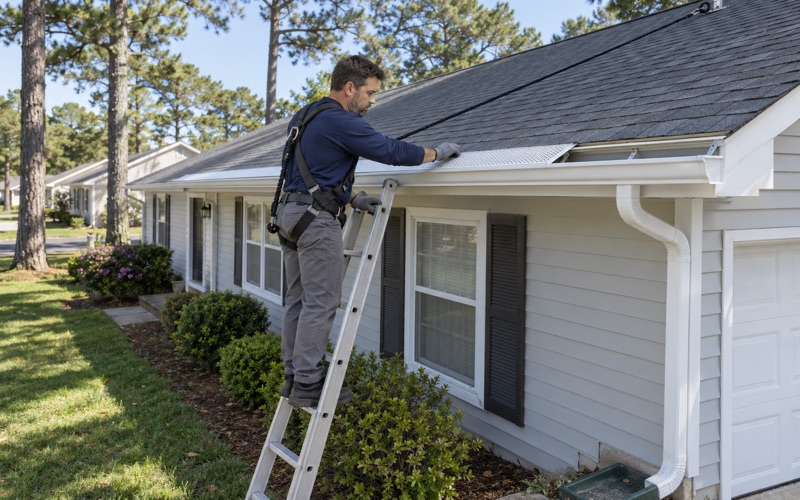
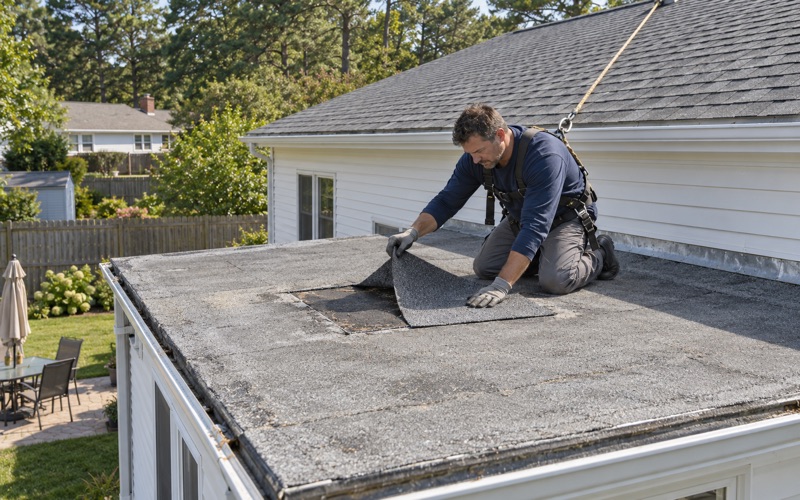
Our first job on any call is to tell you whether the roof can be repaired. Replacement only comes up after that question has a clear answer, and when a leak is the reason you called, we go into the attic as well as onto the shingles. Water rarely enters where the stain appears, so we follow it back to the true entry point before anything is priced.
When a replacement does make sense, the estimate we hand you breaks tear-off, decking, underlayment, flashing, ventilation and gutters into separate lines. That format lets you set our number beside any other contractor’s and compare the work item by item rather than guessing what a single total includes. The rest of this page covers what we see on the township’s homes and why it matters.
Robbinsville’s Town Center and the Standards Behind It
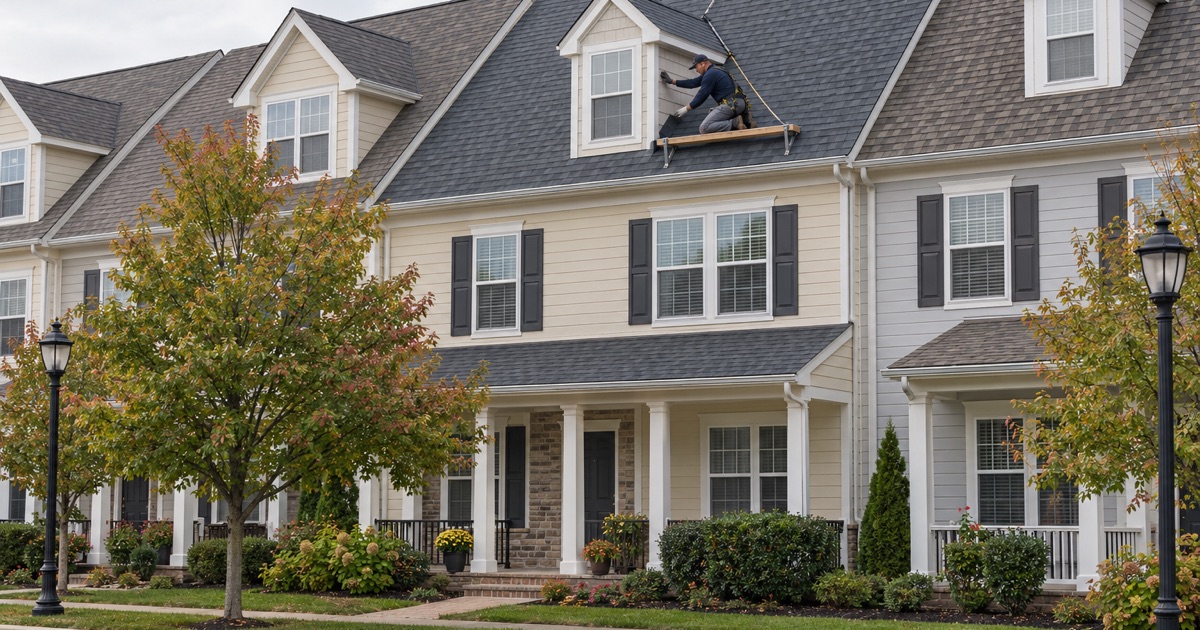
The Town Center is a 140-acre planned neighborhood that Sharbell Development broke ground on in early 2000. It holds roughly 1,000 homes. The early phases were single-family houses, townhomes and duplexes, and later phases added apartments over shops. Local leaders in the late 1990s did not want another standard subdivision, and the result is a mixed neighborhood rather than rows of identical lots.
Building types the township codified
What sets the neighborhood apart is that its building types, architectural standards and street plan were codified by the municipality and carried out by Sharbell as master developer. The township’s Land Use Ordinance, Chapter 142, lists Town Center Zoning and Design Regulations as an appendix. Those design standards are the reason rows of homes read as one composed streetscape rather than a mix of styles.
We never assume what that appendix says about roofs for a given home. Before we quote a Town Center job, we ask you to check what applies to your home, and we plan our material proposal around whatever you learn. A replacement here should look like it belongs on the block, not like a patch dropped into a carefully planned row.
Why a uniform look changes the job
In a neighborhood designed to look of a piece, the shingle profile, color family and trim details all carry visual weight. When one home is reroofed with a noticeably different product, it stands out from the whole street. We bring physical samples of architectural shingles such as GAF Timberline HDZ, Owens Corning Duration and CertainTeed Landmark so you can hold them up against your neighbors’ roofs in daylight.
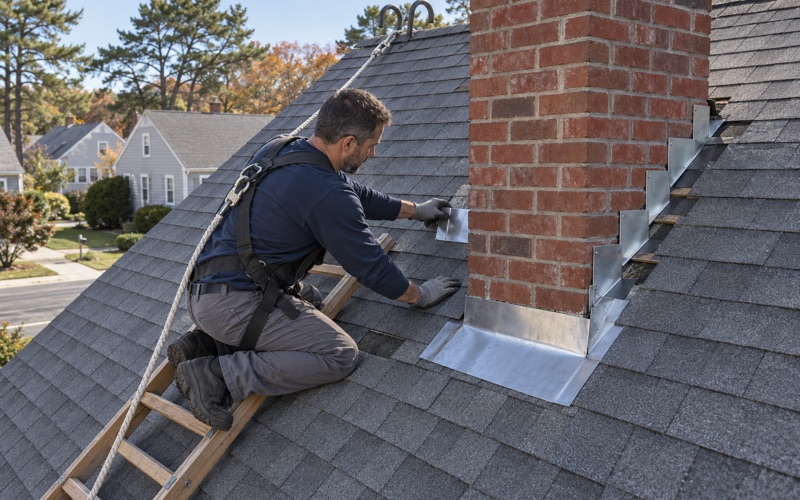
The same care applies to metal details. Drip edge at eaves and rakes, step flashing along sidewalls and the ridge vent profile are all visible from the sidewalk on compact lots. We match those components to what is already on the building wherever practical, and we spell out every one of them in the written scope so nothing is substituted quietly.
A township that grew quickly
Robbinsville was incorporated as Washington Township in 1859 and took its current name on January 1, 2008, after voters approved the change in 2007. The population roughly tripled between 1980 and 2000, and the 2020 census counted 15,476 residents, the township’s highest decennial count ever. That growth is why so much of the housing stock shares a narrow band of ages.
Looking for roofing closer to Point Pleasant? See Roofing in Point Pleasant.
First-Generation Roofs Reaching Replacement
Census figures count 1,340 homes in Robbinsville built between 2000 and 2009. Based on those build dates, the first Town Center roofs are now in the range of 20 to 25 years old. That is an inference from construction decades, not a verdict on any particular building, and plenty of roofs that age still have useful life. It does mean owners should know where theirs stands.
What we look for on a 2000s roof
On a roof from this era, we check for granule loss in the gutters, shingle tabs that have lost their seal, cracked or split pipe boots, and lifting along the rakes. Inside the attic, we look at the decking for staining, check that ridge vent and soffit intake are balanced, and note any frost or moisture marks from poor airflow. Each finding goes into the report with photos.
If the roof has years left, we say so and recommend targeted repairs. If it is close to the end, we lay out the replacement scope in separate lines so you can budget ahead rather than reacting to a leak. Many owners prefer to plan the work for a dry stretch in spring or fall instead of scrambling after a storm.
Decking surprises, handled in the open
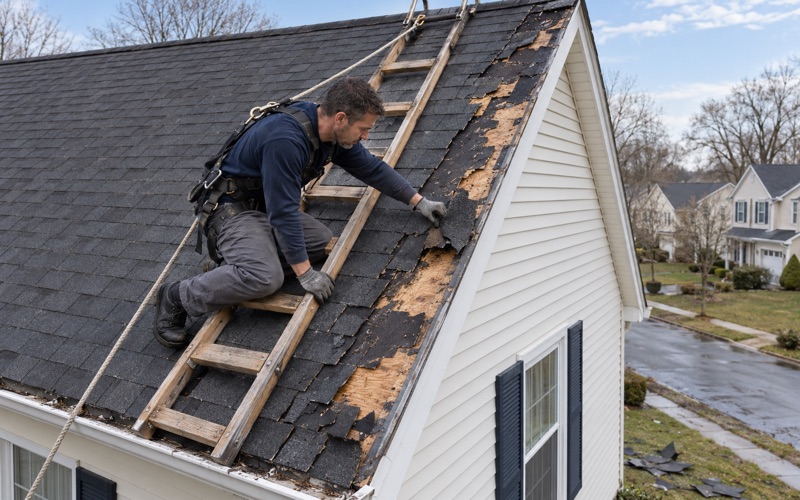
No one can see every sheet of decking until the old shingles come off. When we find rot or delamination during tear-off, we photograph it and show you before replacing a single board. The contract sets a per-sheet price in advance, so the cost of a soft section is never a negotiation on the day. You decide with the evidence in front of you.
Wind ratings tied to your address
New Jersey publishes design wind speeds by exact address under DCA Bulletin 19-1, and we look up the figure for your home rather than relying on a township-wide assumption. That number guides whether we specify shingles tested to ASTM D3161 Class F or ASTM D7158 Class H, and whether a six-nail fastening pattern belongs in the scope. The rating appears on the estimate.
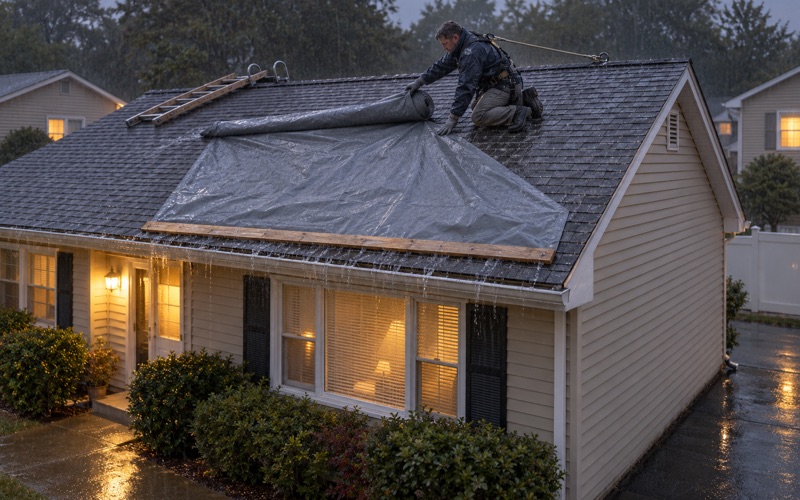
Robbinsville sits in National Weather Service forecast zone NJZ015, served by the Mount Holly office, and the township has issued a severe thunderstorm alert warning of possible damage to roofs, siding and trees. When a storm does hit, we photograph the damage and write it up for your own insurance claim, and we will meet the adjuster on site if you ask us to.
Townhomes, Duplexes and Shared Rooflines
Census data counts 1,607 one-unit attached homes in Robbinsville, about 26.6 percent of all housing in the township, and owners occupy 1,335 of them. Townhomes and duplexes near Route 33 and throughout the Town Center account for a large share of the township’s roofs. Working on attached homes is different from working on a freestanding house, and the differences start before any material is ordered.
Permits on attached units
In New Jersey, replacing the roof covering on a detached one- or two-family house is ordinary maintenance and needs no permit under N.J.A.C. 5:23-2.7. Attached townhomes fall outside that rule, so reroofing one is permit work. We build the permit step into the schedule for attached units from the start, so it never becomes a delay discovered after materials have been delivered.
Knowing whose roof it is
Ownership of a townhome roof is not always obvious. Before we price anything, we ask to see the master deed or bylaws so you know whether the roof is yours to replace or a matter for the community. Arrangements differ from one community to the next, which is exactly why we read the documents for your specific home instead of assuming.
Tying into the neighbor’s roof
When one unit in a row is replaced and the next is not, the joint between them needs careful work. We install self-adhering ice and water barrier meeting ASTM D1970 along the transition, cut the shingle courses cleanly at the line and blend the ridge so water sheds past the seam. Party wall flashing and step flashing get the same attention, since those joints are where attached roofs most often leak.
We also talk with you about access. On compact lots with shared driveways, staging and debris control have to respect the neighbors on both sides. Our crew cleans the yard, driveway and gutters at the end of every workday and runs a magnet sweep for nails, which matters even more when the next family’s car is parked a few feet away.
The 1980s and 1990s Subdivisions Around It
The Town Center is the newest part of the story, but most of Robbinsville’s homes are older. Census figures count 1,561 homes built in the 1980s and 1,602 built in the 1990s, and the Town Center itself adjoins a planned unit development from the early 1980s. Detached houses make up about 48.5 percent of the housing stock, and the township’s median home value is $568,300.
Second and third roofs on detached homes
Houses from these decades may already have had one replacement, and some may be due for another. If a previous contractor laid new shingles over an old layer, New Jersey’s rehabilitation subcode calls for a full tear-off once there are two or more layers. We check the layer count during inspection so the estimate reflects the real scope from the beginning rather than surprising you once the crew is on the roof.
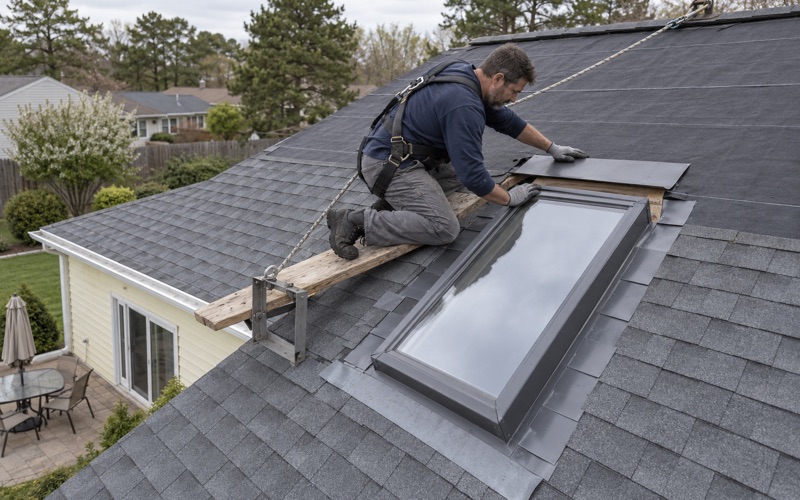
Robbinsville homes have a median of 6.6 rooms, and the larger detached houses often have more complex rooflines than the townhomes nearby. Valleys, dormers, chimneys and skylights all add flashing details. We itemize chimney crickets, counter flashing set in a reglet, apron and kick-out flashing, and skylight flashing kits as separate lines, so you can see exactly where the labor and material are going.
Gutters, ventilation and solar
A new roof works best with matching gutters and balanced airflow. We assess whether existing gutters can stay or should be replaced with seamless aluminum gutters and leaders, and we size ridge vent and soffit intake by net free area. Where solar panels sit on the roof, we put their removal and reinstallation into the schedule ahead of time instead of discovering the problem the morning the crew arrives.
Contracts and paperwork
Every contract we write follows New Jersey’s home improvement rules, including the three-business-day cancellation notice on agreements over $500. If your project qualifies as a capital improvement, we can provide Form ST-8. Whether you own a Town Center townhome or a 1990s colonial on a quiet street, you get the same clear paperwork, the same photographed findings and the same straight answer about repair before replacement.
- 20+ Years in Roofing
- Attic and Roof Leak Checks
- Line-Item Written Scopes