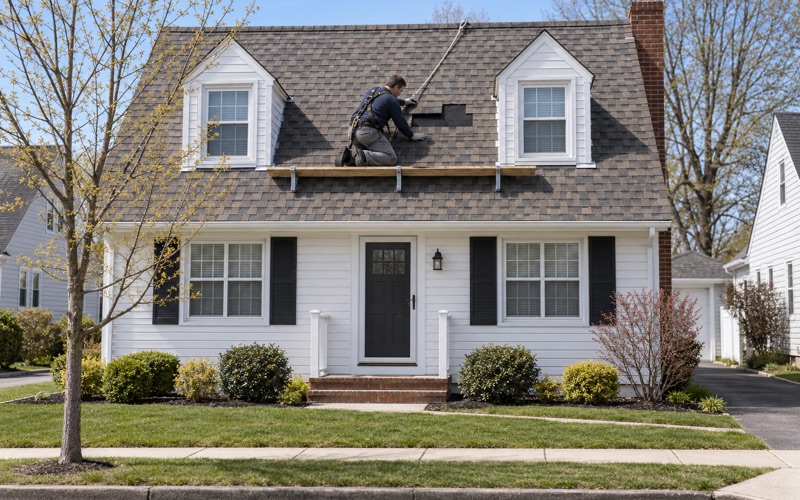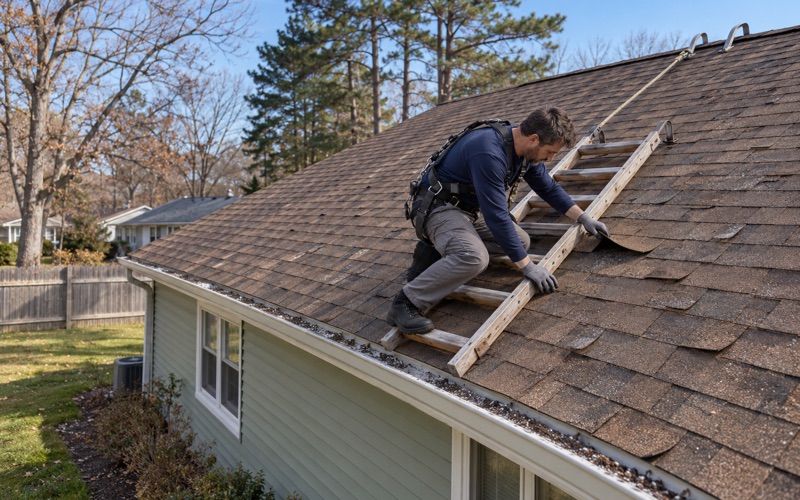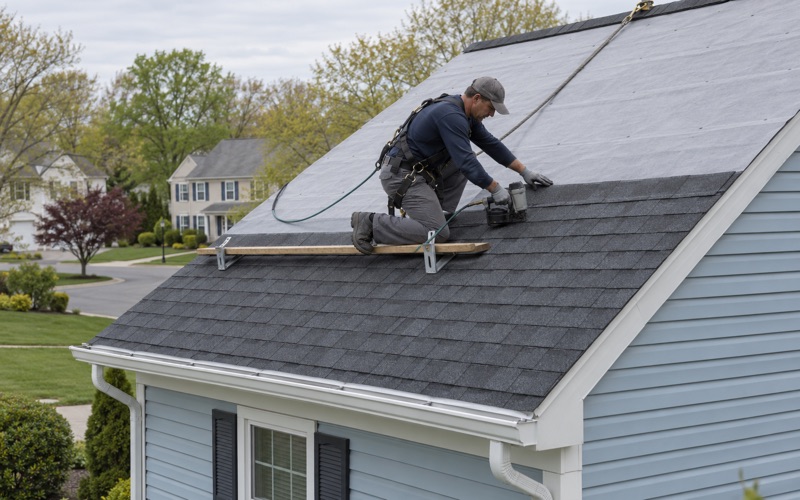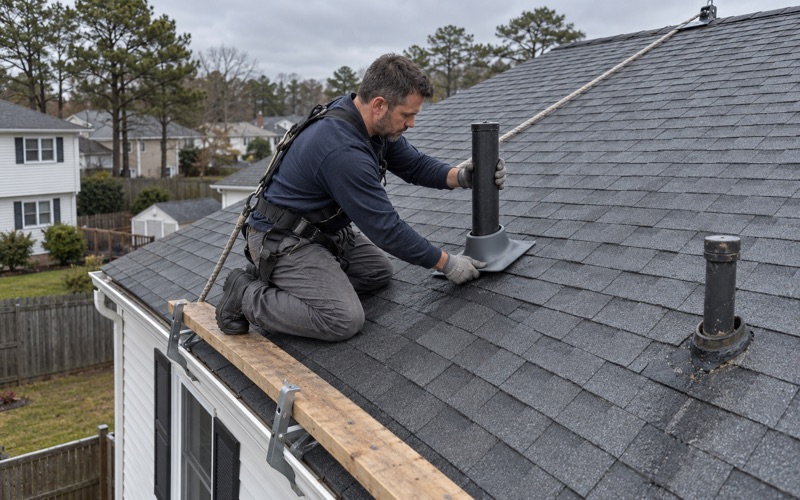
Brick Roofing has spent more than 20 years on roofing in Leisure Village East and the rest of Ocean County, and the work here starts with a question most homeowners never have to ask: whose roof is it? When several households live under one roofline, a missing shingle or a scorched rafter is rarely one owner’s problem alone. Before we talk about materials or price, we help you figure out who is responsible for the part of the building that was damaged.
That order matters because the answer changes everything that follows. If the association maintains the roof and carries the property insurance, the repair moves through the association. If part of the loss falls on your own unit, your own policy and your own decisions come into play. We would rather spend twenty minutes reading the governing documents with you than price a job nobody has authorized.
When the paperwork is settled, the roof work itself is what you would expect from us anywhere: a look from the attic as well as the shingles, an honest call on repair versus replacement, and a written scope broken into separate lines. The sections below explain why this community in particular calls for the paperwork first.
Attached Homes Built From 1970 to 1974
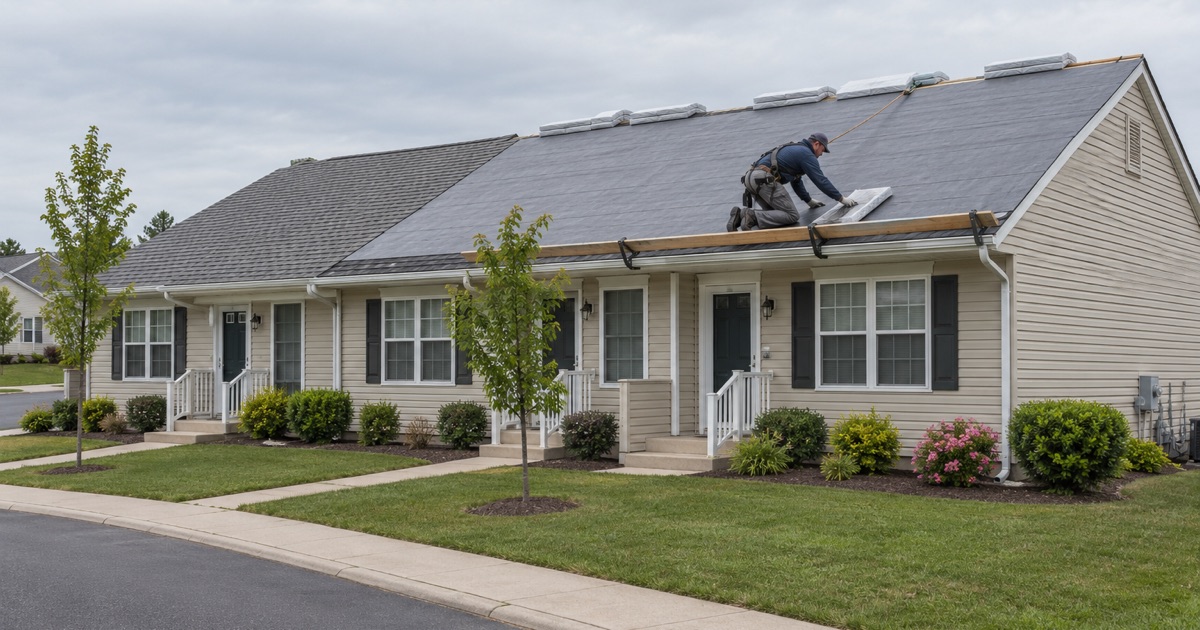
One building, several owners
Leisure Village East is an active adult community in Lakewood Township, and its core is attached housing. According to 55places, the community holds 1,412 attached homes built between 1970 and 1974, offered in five models ranging from 630 to 1,690 square feet. The Census Bureau’s 2024 five-year American Community Survey counts 1,468 owner-occupied attached units across the census-designated place. In a row of attached homes, a single roof assembly spans more than one household.
That structure is the reason a roof call here is different from one on a detached house a few miles away. The shingles over your kitchen may be continuous with the shingles over your neighbor’s living room, and the same ridge, the same underlayment and the same flashing run across both. Any repair or replacement touches a shared building, so the people who share it, and the association that manages it, have a stake in how it is done.
What half a century means for the roof
Homes built in the early 1970s are now more than fifty years old, and nearly every roof covering on them has been replaced at least once since. What sits under the current shingles is the part worth looking at: original decking, older flashing details around vents and walls, and attic ventilation designed to the standards of that era. We check those from inside the attic as well as on top, because a roof that looks fine from the walkway can hide soft sheathing near a party wall.
The age of a building alone does not tell you what to do with it, and we will not use it as a sales argument. A fifty-year-old structure with a sound recent roof may only need a flashing repair. What the age does tell us is to plan for surprises once the old covering is off, which is why our contracts set a per-sheet price for damaged decking and why we photograph it and show you before anything is replaced.
Looking for roofing closer to Brielle? See Brielle Roofing.
What the 2020 Inverness Court Fire Showed
A fire in one unit, damage across four homes
On Saturday, November 7, 2020, a fire was reported at about 4:45 p.m. on Inverness Court. Patch reported two days later that the fire began in one unit, damaged four Leisure Village East homes and destroyed one. The Lakewood Fire Department put it out, and no one was injured. The report did not state the cause or describe how the fire moved from one home to the next, and we will not guess at either.
What the report does make plain is the practical lesson for anyone living in an attached row. A loss that starts behind one front door can end up involving several owners, several unit policies and the association’s own coverage at once. Nobody chose that arrangement on the afternoon of the fire; it was decided decades earlier when the building went up as one structure.
Why the aftermath is a paperwork problem first
After an event like that, the first questions are not about shingle color. They are about which policy answers for the building shell and roof, which answers for each unit, and who has the authority to sign a contract for repairs. Until those questions have answers, any estimate a roofer hands an individual owner is a number with no one clearly able to approve it.
That is why we treat the governing documents as the starting point. For adult communities and associations, we check the master deed or bylaws before anything else so you know whether the roof over your unit is yours or the association’s. It is a slower start than knocking on doors with a clipboard, but it keeps owners from paying for work that was someone else’s to decide.
Association Insurance and Your Own Unit Policy
What the association’s fee is said to include
55places describes the Leisure Village East association fee, quoted at $196 to $357 a month, as covering common area maintenance, bus service, club management and events, as well as property insurance. Some listings also describe the fee as covering siding and roof maintenance. Those are useful starting points, but they are summaries, not the policy itself. We have not read the master policy, and we will not tell you what its deductible is or what it pays for.
The association’s own documents are the only reliable source on those terms. If you are not sure where to find them, the association office at Barton Hall Recreation Center is the place to ask. When an owner shares the relevant pages with us, we read them alongside you so that the scope we write matches what the association actually maintains.
The HO-6 policy beside the master policy
Many owners in attached communities carry an HO-6 policy, the type written for individual units inside a building that an association insures. Where the master policy stops and the HO-6 begins depends on the wording of both documents, and it varies from one community and insurer to the next. Your own agent is the person who can tell you exactly what your unit policy picks up.
We raise it because owners are often surprised by the gap between the two. A storm or fire can damage the roof, the attic and a unit’s finished interior in the same event, and those pieces may not land on the same policy. Knowing in advance which of your belongings and finishes your own policy covers is far easier than learning it while you wait on an adjuster.
What we put in writing for a claim
When storm damage is part of the picture, we photograph it and write it up so the owner or the association has a clear record to submit. If you ask, our crew will meet the insurance adjuster on site and walk the roof with them. We do not negotiate a claim on anyone’s behalf, and decisions about the claim stay with the policyholder.
Our estimates list tear-off, decking, underlayment, flashing, ventilation and gutters as separate lines. That format helps in an attached building, because the association and individual owners can see which items touch shared components and compare our numbers with another contractor’s line by line.
Who to Call First After a Storm or Fire
The association comes before the roofer
If a storm opens up shingles over your row, or a fire damages your building, call the association first. They need to know about damage to a building they insure and, by most accounts, maintain, and they may already have an adjuster or a contractor engaged. Calling a roofer before the association has heard about it can create a second, competing set of decisions about the same roof.
Once the association knows, you are in a much better position to ask what part of the work, if any, is yours. If the answer is that the association handles the roof entirely, we are glad to help the association directly. If some of it falls to you, we can inspect, photograph and price that portion with the boundary clearly drawn.
Code review for attached buildings
New Jersey treats roof-covering replacement on a detached one- or two-family dwelling as ordinary maintenance under N.J.A.C. 5:23-2.7. Attached rows like those in Leisure Village East fall outside that exemption, so roof work on them goes through the local enforcing agency, which here is Lakewood Township. We build that step into the schedule rather than treating it as an afterthought.
We also write every contract to New Jersey’s home improvement rules, including the three-business-day cancellation notice. In a community where an owner may be signing after a stressful event, that window gives everyone time to confirm the association has approved the work before a crew arrives.
What the visit looks like
When we come out, we start in the attic to trace where water or smoke actually entered, then go up to the roof to confirm it. We match shingle wind ratings to the design wind speed for your exact address, and we tell you plainly whether the damage can be repaired before replacement is even mentioned. If a repair will do the job, that is what we recommend.
At the end of every work day we clean the walkways, driveway and gutters and run a magnet sweep for roofing nails. In a gated community where neighbors walk past each other’s doors every morning, leaving the grounds the way we found them matters as much as the roof itself.
- 20+ Years in Roofing
- Attic and Roof Leak Checks
- Line-Item Written Scopes