Brick Roofing handles commercial roofing in Brick, NJ, serving surrounding cities including Point Pleasant, Leisure Village East, Brielle, Point Pleasant Beach and Leisure Village. For more than 20 years we have repaired and replaced roofs on shops, offices, restaurants, small warehouses and mixed-use buildings, many of them sitting a short distance from salt water and fully exposed to coastal wind.
Commercial roofs are mostly flat or low-slope, and they fail differently from the pitched shingle roofs on houses. Water does not run off quickly; it sits, finds open seams and travels under the membrane before it shows inside, sometimes a long way from the actual opening. That makes careful inspection, a clear diagnosis and good drainage the starting points of every commercial job we take on.
Our estimates break the work into separate lines, covering tear-off, insulation, membrane, flashing, edge metal and drainage, so owners and property managers can compare bids properly, understand exactly where the money goes and plan the budget for each building with confidence.
Commercial Roofing Systems
TPO and PVC Single-Ply Membranes
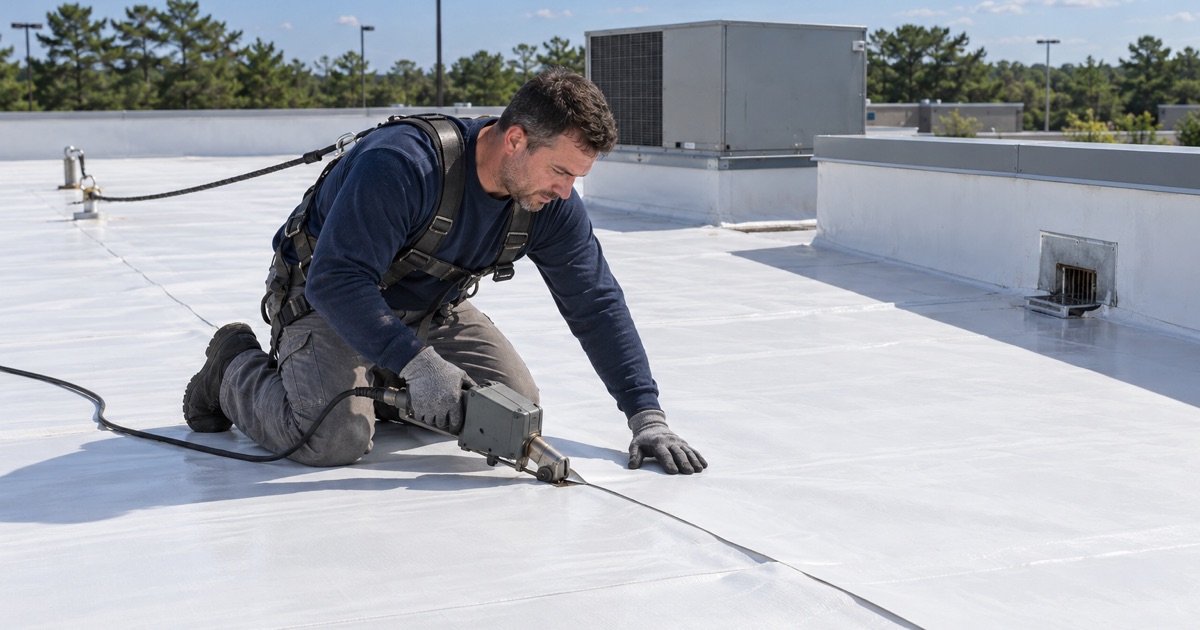
TPO and PVC are single-ply membranes welded together at the seams with hot air, creating a continuous surface across the roof. Their light color reflects summer heat, which can help cooling costs on large, sunny roofs. PVC holds up particularly well where a roof sees grease or chemical exhaust, such as above a restaurant kitchen, while TPO is a common choice for general commercial roofs.
Because the seams are heat-welded rather than glued, a well-installed single-ply roof has very strong joints. We probe every seam after welding to check it has fused properly, since a single cold weld can let water travel a long way under the membrane before anyone sees a stain inside.
EPDM Rubber Roofing
EPDM is a synthetic rubber membrane that has been used on low-slope roofs for decades. It stays flexible through cold winters and hot summers and is relatively straightforward to repair. We install and repair EPDM with compatible seam tapes, primers and flashings, because mixing incompatible products is a common reason rubber roof repairs fail early.
Modified Bitumen
SBS and APP modified bitumen roofs are built from layered asphalt-based sheets, often torch-applied or self-adhered. They tolerate foot traffic well, which helps on roofs where technicians regularly service HVAC equipment. We repair blistered, split or loose sections and replace failing modified bitumen roofs with a properly detailed new system.
Commercial Roof Repairs
Seams, Flashing and Curbs
Most commercial leaks start at seams, at the flashing where the roof meets parapet walls, or around the curbs that hold rooftop units, vents and hatches. We find the actual entry point, repair the membrane and flashing with matching materials, and check nearby details that are showing the same kind of wear.
Rooftop equipment brings its own risks. Service technicians can puncture a membrane with dropped tools or panels, and units that vibrate can work flashing loose over time. Where traffic is heavy, we add walkway pads to protect the membrane along the routes technicians actually use.
Ponding Water and Drainage
Water that stands on a flat roof for days after rain shortens the membrane’s life and adds weight to the structure. We clear and repair drains, scuppers and gutters, and where the roof has low spots we discuss tapered insulation or additional drainage to move the water off.
Drains clogged with leaves, sand and debris are a frequent cause of sudden commercial leaks, because a blocked drain turns a light rain into standing water across a whole section of roof. We clear drains during every visit, check that strainers are in place, and recommend a cleaning schedule based on the trees and debris around the building.
Edge Metal and Wind
Commercial roofs often fail first at the edges, where wind lifts the membrane and edge metal. Near the ocean and the bay, that wind load is significant and salt air corrodes ordinary fasteners. We secure edge metal and copings with corrosion-resistant fasteners and repair lifted perimeter membrane before it peels further.
Replacing a Commercial Roof
Recover or Tear-Off
A recover, installing a new membrane over a sound existing roof, can save money when the existing roof is a single layer and the insulation below is dry. When there are two or more layers, or the insulation is wet, a tear-off is the right call, and New Jersey’s rehabilitation subcode limits further layering. We test and inspect before recommending either.
Insulation and Deck
A roof replacement is the time to address insulation. Wet insulation is removed and replaced, and new insulation can be tapered to improve drainage. Any damaged deck found during the tear-off is photographed and shown to the owner before it is repaired, at a price agreed in the contract.
Permits and Scheduling
Commercial and multi-unit buildings fall outside New Jersey’s ordinary-maintenance exemption for roof coverings, so replacements generally go through the local construction office. We handle the scope and scheduling with that in mind and plan the work around your business hours so the building can stay open.
Workers on a commercial roof need fall protection near unprotected edges, skylights and roof openings. We set up guarding, warning lines or personal fall arrest as the roof requires, and plan where materials are lifted and stored so the roof structure is not overloaded in one spot during the job.
Associations and Multi-Unit Buildings
Owner or Association Responsibility
For condominiums and associations, the master deed or bylaws decide who is responsible for each roof. We check those documents first so the right party makes the decision, and we provide boards with inspection reports and itemized scopes for planning.
Reserve Study Planning
New Jersey’s capital reserve study law for planned real estate developments, P.L.2023, c.214, requires associations to study and fund the capital assets they maintain, which can include roofs. Our condition reports and line-item scopes help boards and their reserve specialists plan replacement timing and costs.
- 20+ Years in Roofing
- Attic and Roof Leak Checks
- Line-Item Written Scopes