
Brick Roofing takes on chimney repair in Brick, NJ, serving surrounding cities including Point Pleasant, Leisure Village East, Brielle, Point Pleasant Beach and Leisure Village. Over 20+ years of tracing roof leaks, we have found that chimneys cause more of them than almost any other part of the roof, because they combine a roof joint, a masonry structure and a top surface that faces the weather all year.
Our chimney work focuses on keeping water out: the flashing where the roof meets the brick, the cricket that steers water around a wide chimney, and the crown, cap and mortar that protect the masonry from above. Each one fails in its own way, and each one needs the right repair rather than another bead of sealant spread over the problem.
Every chimney leak is checked from the attic as well as from the roof. Water can run down inside the masonry or along the framing beside it before it shows on a ceiling, and seeing both sides is how we find which part of the chimney is actually letting it in.
Chimney Flashing
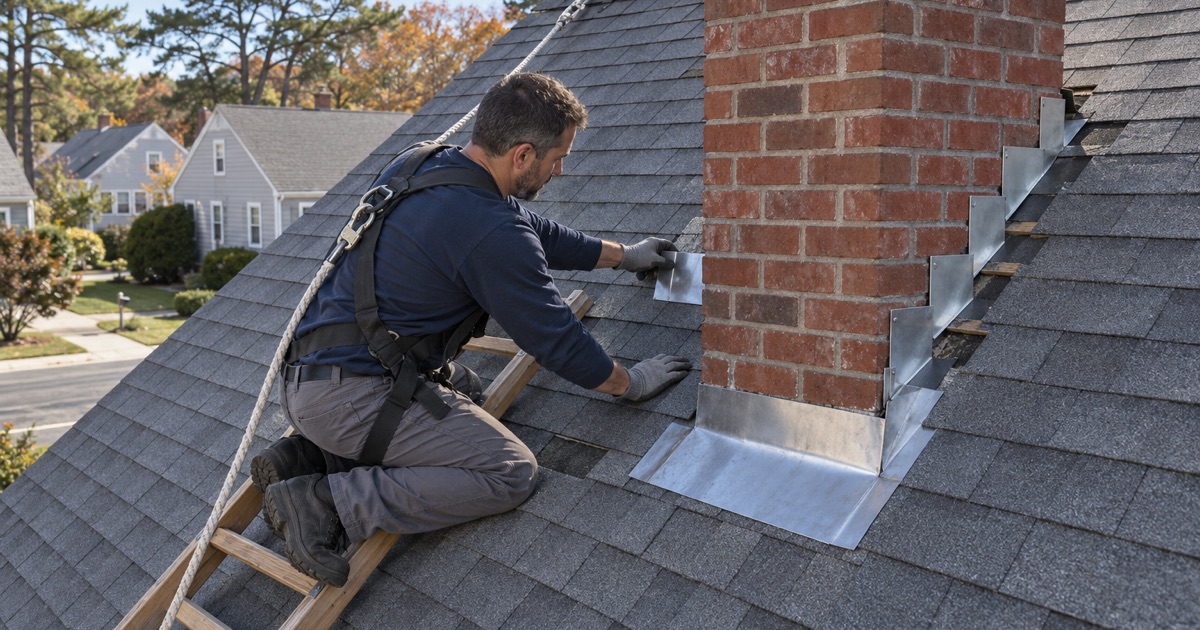
Step Flashing Along the Sides
Where a chimney passes through a sloped roof, step flashing is installed piece by piece with each course of shingles, overlapping like the shingles themselves, and turned up against the brick. When it is missing, rusted or simply covered in old roof cement, water runs behind the shingles and down beside the chimney into the attic and ceiling below.
We remove the shingles along the chimney, replace the step flashing with new pieces sized to each course, and reinstall shingles over it. On homes near the ocean and the bay, we choose flashing metal and fasteners suited to salt air, so the repair does not corrode years ahead of the rest of the roof.
Counter Flashing Set Into the Mortar
Step flashing alone leaves a gap at the top edge against the brick. Counter flashing covers that gap. We cut a groove, or reglet, into a mortar joint, set the counter flashing into it and seal it, so water running down the chimney face is directed over the step flashing rather than behind it.
On many older chimneys the counter flashing was simply face-nailed to the brick and smeared with sealant. That joint opens as the sealant ages and the brick moves with the seasons. Cutting it properly into the mortar is more work, but it is what makes the repair last.
Apron Flashing at the Front
On the downhill side of the chimney, a single apron flashing piece wraps the face and laps over the shingles below. If it is bent, short or corroded, water collecting at the base of the chimney can find its way under the roofing. We replace the apron and tie it into the step flashing at both corners.
Crickets for Wide Chimneys
Why Water Collects Behind a Chimney
A chimney sitting partway down a roof acts like a dam. Rain, melting snow, leaves and pine needles run down the slope and pile up against its uphill face. On a wide chimney that pool can sit for hours after a storm, and in winter it can freeze, pushing water under the shingles and flashing.
Building a Cricket
A cricket, also called a saddle, is a small peaked structure framed on the uphill side of the chimney. It splits the water and sends it around both sides of the chimney instead of letting it collect. We frame and sheath the cricket, cover it with ice and water barrier and flashing, and tie it into the surrounding roof.
Crickets are easiest to add during a roof replacement, when the shingles around the chimney are already off. On a roof that is otherwise in good condition, we can still build one as a separate repair and blend the new roofing into the existing slope.
Crowns, Caps and Masonry
Chimney Crowns
The crown is the concrete or mortar slab that covers the top of the chimney around the flue. Cracks from freeze and thaw let water into the masonry below, where it works down to the attic or the flashing. We seal small cracks and rebuild crowns that are badly cracked or crumbling, shaped to shed water past the face of the brick.
Chimney Caps
A cap sits over the flue opening and keeps rain, snow, birds and animals out of the chimney. Without one, water runs straight down the flue. We install caps sized to the flue, and near salt water we choose cap materials that hold up to the corrosion that quickly ruins ordinary steel.
Repointing Mortar Joints
Mortar wears away faster than brick, especially on the side facing the prevailing wind. Eroded joints let water soak into the chimney and freeze inside it, gradually loosening the bricks. Repointing removes the damaged mortar to a sound depth and replaces it with fresh mortar packed into the joints.
Repointing also gives the counter flashing a solid joint to sit in. When we reflash a chimney with badly worn mortar, we repoint the joints at the flashing line first, so the new reglet is cut into sound material.
Chimney Repairs and the Roof
Combining With a Roof Replacement
With the shingles off during a replacement, new step, counter and apron flashing can be installed correctly and a cricket added if needed. We list each chimney item as its own line in the estimate, so you can see what the chimney work costs separately from the rest of the roof.
Chimneys on Older Brick Homes
Many Brick homes date from the 1950s through the 1970s, and their chimneys have often been through several re-roofs with the original flashing patched each time. Layers of roof cement and old flashing can hide rot in the framing around the chimney. We open up the area, show you what we find with photographs, and repair it properly.
- 20+ Years in Roofing
- Attic and Roof Leak Checks
- Line-Item Written Scopes